Executive Office Building
All the President's MenThe Executive Office Building was more than a nearby administrative address in the Watergate investigation: its basement housed the White House Plumbers, while a separately billed telephone in room 16 left a paper trail connecting their work to John Ehrlichman’s office. The contrast was telling. The leak investigators operated from a White House-adjacent office, yet a telephone associated with their work was installed under another person’s name and handled through an unusual billing arrangement. Once reporters identified the office, the building’s ordinary institutional geography became evidence of how the operation was organized and concealed.
Setting and institutional position
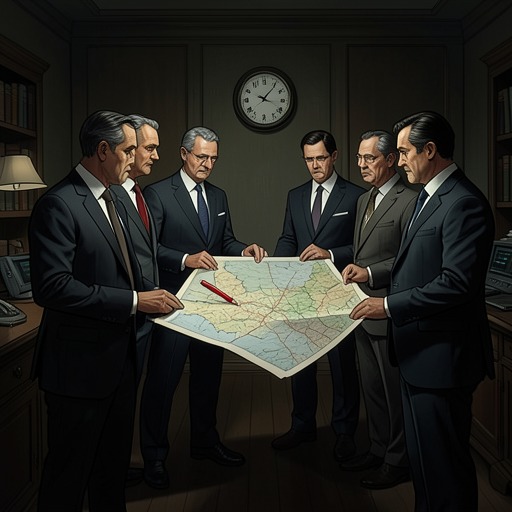
The White House Plumbers’ office was in the basement of the Executive Office Building, across from the White House. Kathleen Chenow, whose name was later used for the room 16 telephone, described the Plumbers as Howard Hunt, Gordon Liddy, David Young, and Egil Krogh. She had been Young’s secretary; Young was technically assigned to her and was on loan to Ehrlichman’s staff from Henry Kissinger’s office. Krogh was one of Ehrlichman’s principal deputies. The arrangement placed the unit physically close to the White House while giving it a distinct office and a staff structure that ran through Young and Krogh to Ehrlichman.
Young regularly reported to Ehrlichman on the progress of the Plumbers’ investigations. That reporting line matters to the building’s significance: the basement office was not merely a place where staff happened to work, but the base of a group whose findings were communicated to a senior White House aide. Chenow’s account also clarified her own position within the office. Although she worked for Young, she could identify the people in the unit and explain its assignment, making her a direct source on the building’s occupants and the work conducted there.
Room 16 and the disguised telephone
A confidential legal stipulation obtained by city reporter Lawrence Meyer described telephone, travel, and bank records accepted as accurate by the prosecution and defense. Among those records was a telephone installed on August 16, 1971, in room 16 of the Executive Office Building, at 17th Street and Pennsylvania Avenue N.W. in Washington, D.C. It was disconnected on March 15, 1972, and registered under the name and home address of Kathleen Chenow, of Alexandria, Virginia. The address and dates made a specific room in the building part of the documentary record of the leak investigations.
Chenow’s name did not appear in the telephone book. Using a crisscross directory, Carl Bernstein located a former roommate, learned that Chenow had moved to Milwaukee, and reached her there. She identified herself as the Plumbers’ secretary and explained the office’s composition and purpose. The discovery therefore proceeded from an apparently routine record to a concealed staff function: a room number led to a name, the name to a former roommate, and that contact to a source able to describe the basement office from within.
The next morning, Bob Woodward called Jack Harrington, the Chesapeake & Potomac Telephone Company official responsible for White House service. Harrington confirmed that Ehrlichman’s office had ordered the phone and arranged the billing system, which he said was the first of its kind he had seen in twenty-five years. White House sources also identified John Campbell as Ehrlichman’s office manager and said that the phone would not have been installed without Ehrlichman’s approval. The building’s address, Chenow’s name, and the billing arrangements thus converged on Ehrlichman’s office rather than remaining an unexplained telephone entry.
Work conducted from the basement
Chenow described an operation that had begun with an effort to compare the New York Times version of the Pentagon Papers with the documents themselves, then shifted toward finding how the papers had been leaked. The investigations broadened to State Department leaks. Staff checked embassy cables and tried to trace which desks they had crossed; much of Hunt’s work that Chenow saw involved reviewing State Department cables related to the substance of the Pentagon Papers. The basement office was therefore tied to a continuing search for the sources and routes of leaks, not simply to a single inquiry.
Chenow also described what followed the Watergate break-in. After returning, she reported to John Dean’s office at 8:45 the next morning. Dean told her that the FBI would interview her at nine and ask about her role and whether she knew of the bugging; Fielding and Young were present, but neither Dean nor the others asked questions during the roughly forty-minute interview. Young knew the telephone had been installed, Chenow said, and later seemed to connect it with the bugging once the affair became public. She met with the Watergate prosecutors and testified before the grand jury that same week. She said prosecutor Earl Silbert asked about Charles Colson, Hunt, Liddy, and Young, but not Ehrlichman.
Discovery and narrative significance
The reporters’ account of the building emerged through corroboration rather than Chenow’s testimony alone. After her interview, Woodward’s call to the telephone-company official verified who had ordered the room 16 line and how it was billed; White House sources separately described the approval required for its installation. Bernstein completed a story combining the telephone record, Chenow’s account of the Plumbers, and her description of her interview with Dean. The White House declined to comment, saying a response might affect the approaching trial, leaving unanswered how Hunt’s official duties could require a camouflaged listing and why Ehrlichman’s office had approved the service.
The Executive Office Building consequently occupies two connected roles in the account: it was the physical workplace of the Plumbers and the address through which their concealed communications could be traced. Its basement office supplied the organizational setting; room 16 supplied a precise, checkable record. Together, the building’s location, the telephone’s false listing, Chenow’s identification of the unit, and the confirmation of Ehrlichman’s office involvement turned an obscure administrative detail into a route for reconstructing the White House leak-investigation operation.